


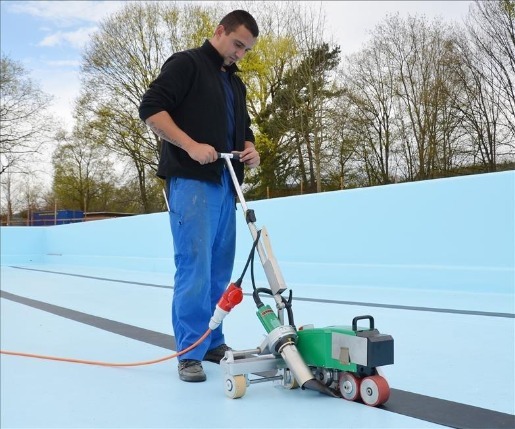
Automation – it seems like it’s everywhere nowadays. And welding is no exception. Why? Because automation allows for improved accuracy, better safety, and faster processes. Ultimately, automation is taking the welding world to an all new level.
Many industries are jumping on board the welding automation train because of the advantages. But what exactly is automatic welding? Below, we’re going to dive into the ins and outs of how automatic welding works to answer any questions you may have.
What is Automatic Welding?
Automatic welding is a term used to describe a welding operation that, at its most advanced level, does not require a human operator to be involved in the process. Automatic welders can be left to run by themselves and don’t require any manual adjustment while the process is taking place. In fact, once parameters are set within the machine, they cannot be adjusted. The only thing the operator must do is to start the machine and keep an eye out when errors and defects, if any, occur.
The best type of welding operation that works well with automatic welding is the more repetitive welds. This makes it the perfect solution for factories with repetitive processes making identical parts in their factory line. You’ll find that this is perfect for quick welding, too, with some machines being almost five times faster than manual welding.
However, when you want something beyond a repetitive weld, robotic welding is the way to go because it is one of the more advanced levels of automatic welding, where the work completed is done by robots. Robotic welding can be programmed to do different types of welding, not just repetitive welds.
How Does Automatic Welding Work?
An automatic welder is a system that goes through a cycle to complete the task. However, some key elements of an automatic welder machine are important in understanding how it works. The key components involved are:
- Welding cycle controller – known as the most important part because it controls the welding operations and times how long each stage takes.
- Robotic or mechanical arm – often moving in three dimensions in place of the human operator.
- Wire feeder – when a welding job needs to start, the wire feeder will send a filler wire (linear welding electrode) to the robot to commence the operation. As and when it is needed, it will feed the wire to the arm and torch. An automatic welder uses much less wire (as well as power and time) than manual welding.
- High heat torch or welding head that can reach extremely high temperatures – this is where the welding takes place. It melts the base metal to induce fusion.
Most automatic welding machines are able to load the work into the welding station themselves. The automation performs the entire process without the need to have a human operator involved. Plus, the automatic welder plans, organizes, and monitors the entire process before carefully evaluating the steps.
Although automatic welding does not require an operator to be involved, some semi-automatic welding machines do require an operator. Therefore, how automatic welding works differs ever so slightly depending on the method that you select. For example, while the power source controls the wire feed rate and arc length, operators will manage the speed and positioning.
Automatic vs Manual Welding
In modern manufacturing processes, manual welding still has its role to play. The most likely place in which manual welders are still required is in more complicated jobs that require a range of different styles and techniques. Automatic and robotic welders are better for jobs requiring repetitive processes.
When it comes to adapting, automatic welding doesn’t do so very well, but this may change in the coming months and years. Until then, manual welders are still needed, and in many industries, there’s a shortage of welders.
However, those who have the technical know-how to work alongside automated machines are likely to be in a higher level of demand. Welders who have specific certifications that prove their knowledge are likely to excel in the welding field. Between experienced manual welders and advanced automated machines, welding projects will be completed faster and more cost effectively than ever.
Types of Automatic Welding
There are several types of automatic welding. To be more specific, there are many different types of robotic welding. Let’s take a look at the seven most common ones:
- Arc welding: Arc welding, arguably the most common type of robotic welding, is an electric arc that generates an extremely high heat level, which ensures metal will be melted, joined together, and solidified.
- TIG Welding: Shorthand for Tungsten Inert Gas, this type of welding uses a tungsten electrode that has a high melting point. However, this doesn’t consume the electrode during welding. In other words, it doesn’t melt and become filler metal; therefore, the welder won’t need to balance the heat input. An inert gas shield protects the molten metal. This could be a gas such as helium that stops the metal from reacting with the atmosphere.
- MIG Welding: Also known as Metal Inert Gas Welding, this is best used for pipelines or furniture. Sometimes art objects can benefit from this, too. A thin wire will act as the electrode inside the welding machine and will feed continuously when the trigger is held. This heats both metals and solidifies as one piece.
- Resistance welding: Resistance welding is best used for heat-treated projects. First, pressure is applied to pieces of metal. Next, an electric current passes between the two metal pieces causing the metals to melt and fuse together.
- Spot Welding: Spot welding is a resistant welding process used for welding two (or more) metal sheets. It applies pressure and heat to do this. As the materials melt, they will then fuse together and solidify once the current turns off.
- Plasma Welding: Plasma welding forms an arc – similar to the process of the TIG welding process – but instead of positioning the electrode within the torch, it can be separated from the shielding gas.
- Laser Welding: Laser welding uses a laser beam to join together two metals or even thermoplastics. Considered to be one of the faster welding speeds, it is able to work in two modes. It will work in conduction limited welding or keyhole welding.
Pros and Cons of Automatic Welding
As with most things, there are pros and cons when it comes to automatic or robotic welding.
First, automatic welding pros:
You will get highly accurate and consistent welds each time. The quality of your weld will be unlike any other. Plus, you aren’t at risk of human error occurring due to external factors like a distraction. Because it’s so consistent, you can ensure that every piece produced meets the standards you and your customers expect.
The cleanup is a lot easier to manage.
You can complete the work much faster.
You aren’t restricted to the length of time it can perform to a high standard.
It avoids the need for employees to put themselves in danger.
There are multiple ways that you can save yourself money with automatic welding. First, save on costs of paying for a worker to use manual welding. The speed also makes it a cost-effective option. With limited skilled employees available with these skills, you won’t have to offer a competitive salary to secure the best in the business.
You can minimize the amount of material used. Automatic welders use less wire. Plus, there’s a lot less waste at the end, which saves you money.
Next, automatic welding cons:
The initial cost of setting up can be expensive. You must also factor in the costs to maintain or fix the welder if needed.
If a repair is made or replacement provided, that could cause a loss of production time.
While the machine may be quick, it doesn’t mean you can easily change the task it is doing. It will take time to adjust the configuration to do what you need it to do. Therefore, the lack of flexibility can be a disadvantage.
Automatic and robotic welding is definitely the wave of the future. The technology is continually advancing, so we’re sure to see even more advancements in the near future. Automatic welding machines make the welding process easier, safer, and more efficient. And what does that lead to? A higher quality product that yields higher profits – a total win-win!